

What Moves the Stock Market Each Day?
பங்குச் சந்தை தினமும் ஏன் ஏறி இறங்குகிறது?
Interest rates, company results and global news — the forces behind daily price moves, explained simply.
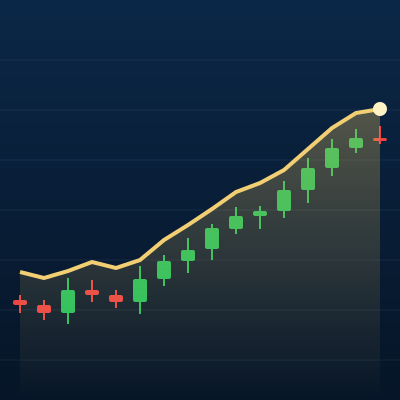
If you follow the news, you will have noticed that share prices go up and down every day. It is natural to ask why. The honest answer is that there is rarely a single reason. Prices are the result of millions of decisions made by buyers and sellers, each reacting to what they expect to happen next.
Buyers and sellers
At its simplest, a share’s price rises when more people want to buy it than to sell it, and falls when more want to sell. What makes people want to buy or sell is their view of the company’s future, mainly how much profit it is likely to earn.
Company results and news
Companies publish their results every quarter. Markets don’t react only to whether the results are good or bad, but to whether they are better or worse than people expected. A company that earns a decent profit can still see its share price fall if investors had hoped for more. News about a company, such as a new product, a change of leadership or a legal problem, can move its price too.
Interest rates and inflation
Interest rates, which in India are influenced by the Reserve Bank of India, affect the cost of borrowing for companies and households. When rates rise, borrowing becomes more expensive and safer options such as bank deposits become more attractive, which can weigh on share prices. When rates fall, the reverse can happen. Inflation matters because it influences what central banks decide to do with interest rates.
The wider world
Markets also react to the economy and to the world beyond. Government budgets and policies, the price of crude oil, the value of the rupee, the mood in other countries’ markets and the buying or selling of foreign investors can all move prices.
Sentiment and surprise
Sometimes prices move simply because people are more worried or more optimistic than they were the day before. New information tends to move prices most when it is unexpected.
A word of caution
After a big move, commentators often explain it neatly. In reality, day-to-day movements are partly random, and explanations given afterwards are often guesses. That is why any single day’s change is best treated with caution.
Key points
- Prices rise or fall when more people want to buy or to sell, based on their expectations.
- Results, interest rates, inflation, policy and global events all play a part.
- Surprises move markets more than expected news does.
- Daily moves are partly random and rarely have one clear cause.
Finance content is for education only and is not investment advice. Market figures are labelled when they are samples.