
How Does the Solar System Work?
சூரியக் குடும்பம் எப்படி இயங்குகிறது?
A friendly tour of the Sun, its eight planets and the invisible pull that keeps them all in orbit.
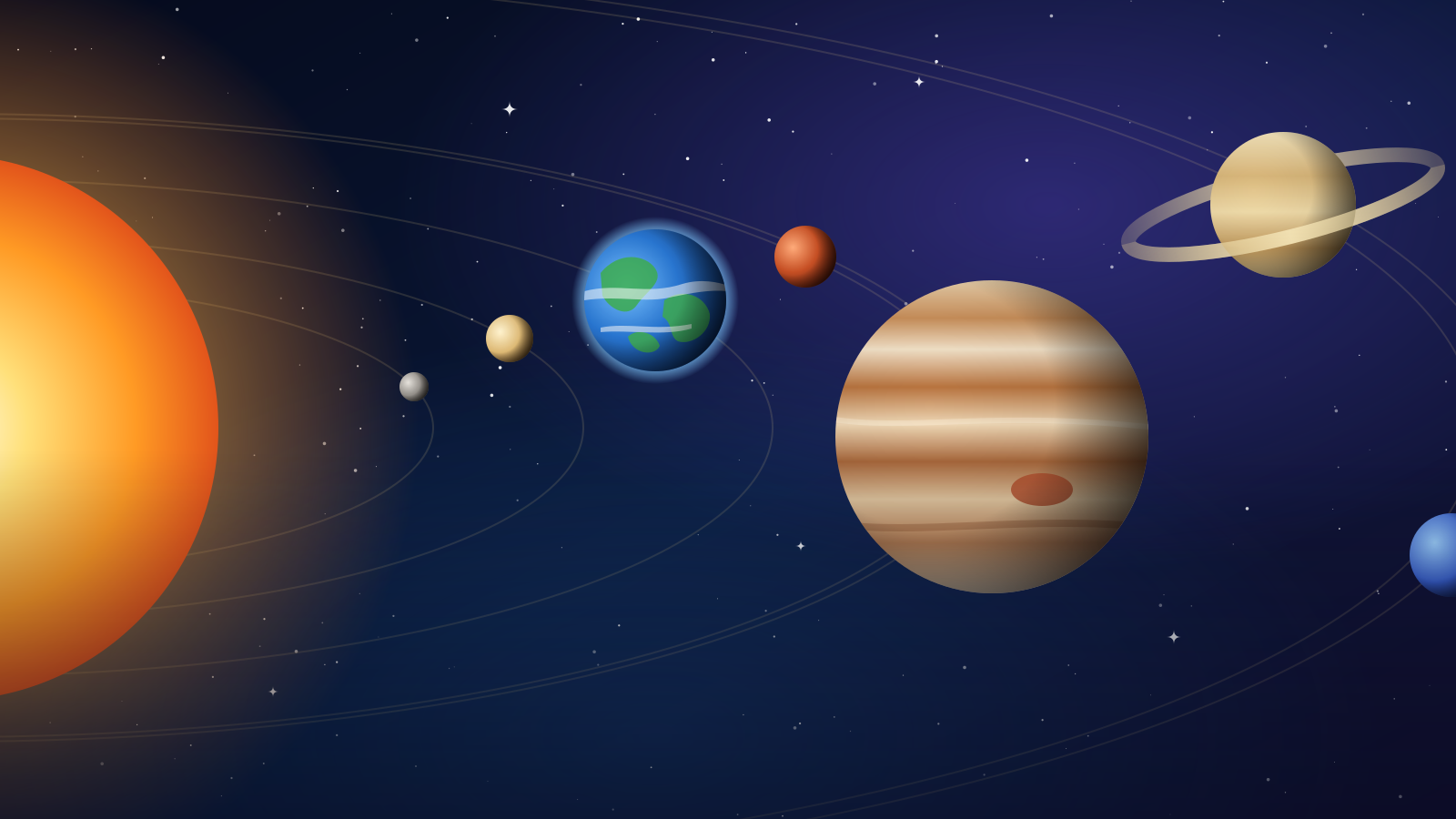
The Solar System is our home neighbourhood in space. At its centre is the Sun, a star. Around it travel eight planets, their moons, and countless smaller objects such as dwarf planets, asteroids and comets. Everything in the system is held together by one thing: gravity.
A star and the things that orbit it
The Sun contains almost all of the mass in the Solar System. Because gravity grows with mass, the Sun’s pull is by far the strongest, and it keeps everything else circling around it. Sunlight takes about eight minutes to travel from the Sun to Earth, which is roughly 150 million kilometres away.
Why the planets don’t fall into the Sun
The Sun pulls on every planet, so why don’t they crash into it? Because the planets are also moving sideways. Imagine swinging a ball on a string: the string keeps pulling the ball inwards, but the ball’s own motion keeps it travelling in a circle instead of falling into your hand. For a planet, gravity plays the part of the string. The curved path that results is called an orbit.
Planets closer to the Sun feel a stronger pull and move faster. That is why Mercury completes a year far more quickly than Earth does, while Neptune, the farthest planet, takes well over a hundred Earth years to go around once.
Two families of planets
The four inner planets — Mercury, Venus, Earth and Mars — are small and rocky. Beyond Mars lies a belt of rocky asteroids. Further out are the four giants. Jupiter and Saturn are mostly gas, while Uranus and Neptune are often called ice giants. All four giants have rings, and many moons.
Smaller travellers
Besides the planets, the Solar System is home to dwarf planets, countless asteroids and comets. Comets are icy bodies that grow glowing tails when their orbits carry them close to the Sun.
A shared beginning
The planets all travel around the Sun in the same direction, in roughly the same flat plane. This is a clue to how they began. The Solar System formed about 4.6 billion years ago from a spinning cloud of gas and dust that flattened into a disc. The Sun formed at the centre, and the planets grew from the material left in the disc.
Key points
- The Sun holds almost all of the Solar System’s mass, and its gravity keeps everything in orbit.
- Planets stay in orbit because they move sideways just as gravity pulls them inwards.
- There are eight planets: four small rocky ones, then four giants.
- The whole system formed from the same spinning cloud of gas and dust.